


Prelude and Background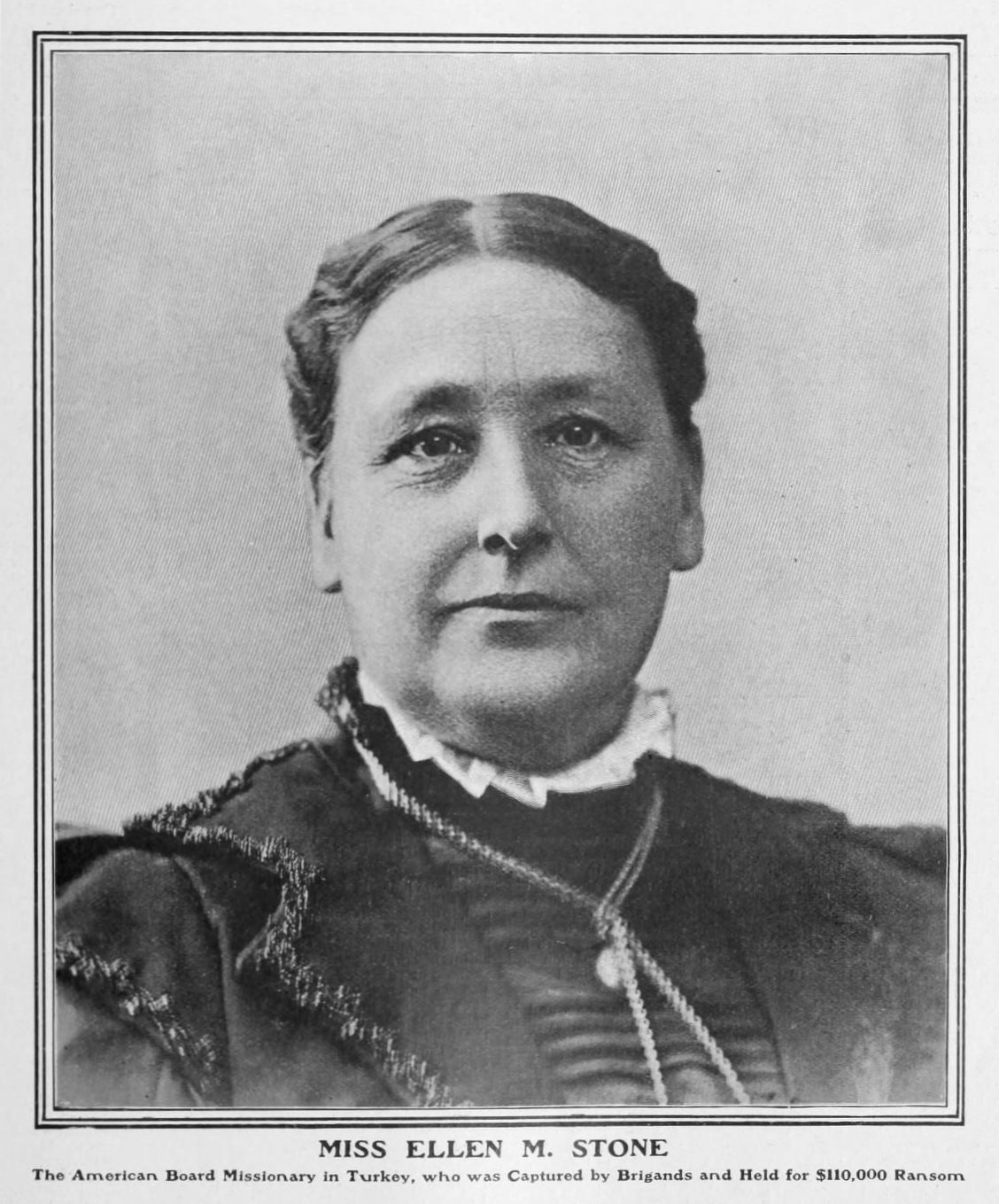
In the late 19th century, American Protestant missionaries were active across the Balkans, spreading education and Christianity under the auspices of groups like the American Board of Commissioners for Foreign Missions (ABCFM)[1][2]. One such missionary was Ellen Maria Stone, a veteran Congregationalist teacher who had served in Bulgaria and Ottoman Macedonia since 1878[3][4]. By 1901, Miss Stone was based in Salonica and frequently toured remote villages to support local Bible women and evangelical converts. Ottoman Macedonia at this time was a restive province: the 1878 Treaty of Berlin had promised reforms and autonomy, but decades of non-fulfillment bred deep dissatisfaction among the Christian populace[5]. The Macedonians formed a revolutionary “committee” – the Internal Macedonian Revolutionary Organization (IMRO) – which “grew in power” through secret societies. Frustrated by the lack of European intervention, more radical IMRO members “accepted the horrible principle... [that] the end justifies the means” and turned to violent tactics to oppose Ottoman rule[6].
Yane Sandanski, a former schoolteacher turned revolutionary, emerged as a leading figure in the IMRO’s struggle. Along with fellow commander Hristo Chernopeev, Sandanski sought bolder methods to finance their cause and draw international attention[7]. They hit upon a daring plan: to kidnap an American citizen and demand a large ransom, thereby both filling the revolutionaries’ war chest and provoking the United States to pressure the Ottomans. The American missionary community – widely respected and even sympathetic to the Macedonian liberation movement – presented an attractive target[8][9]. Sandanski and his band calculated that abducting a prominent missionary might even win covert cooperation or at least begrudging understanding from some missionaries, given their shared loathing of Ottoman oppression[10].
The Kidnapping
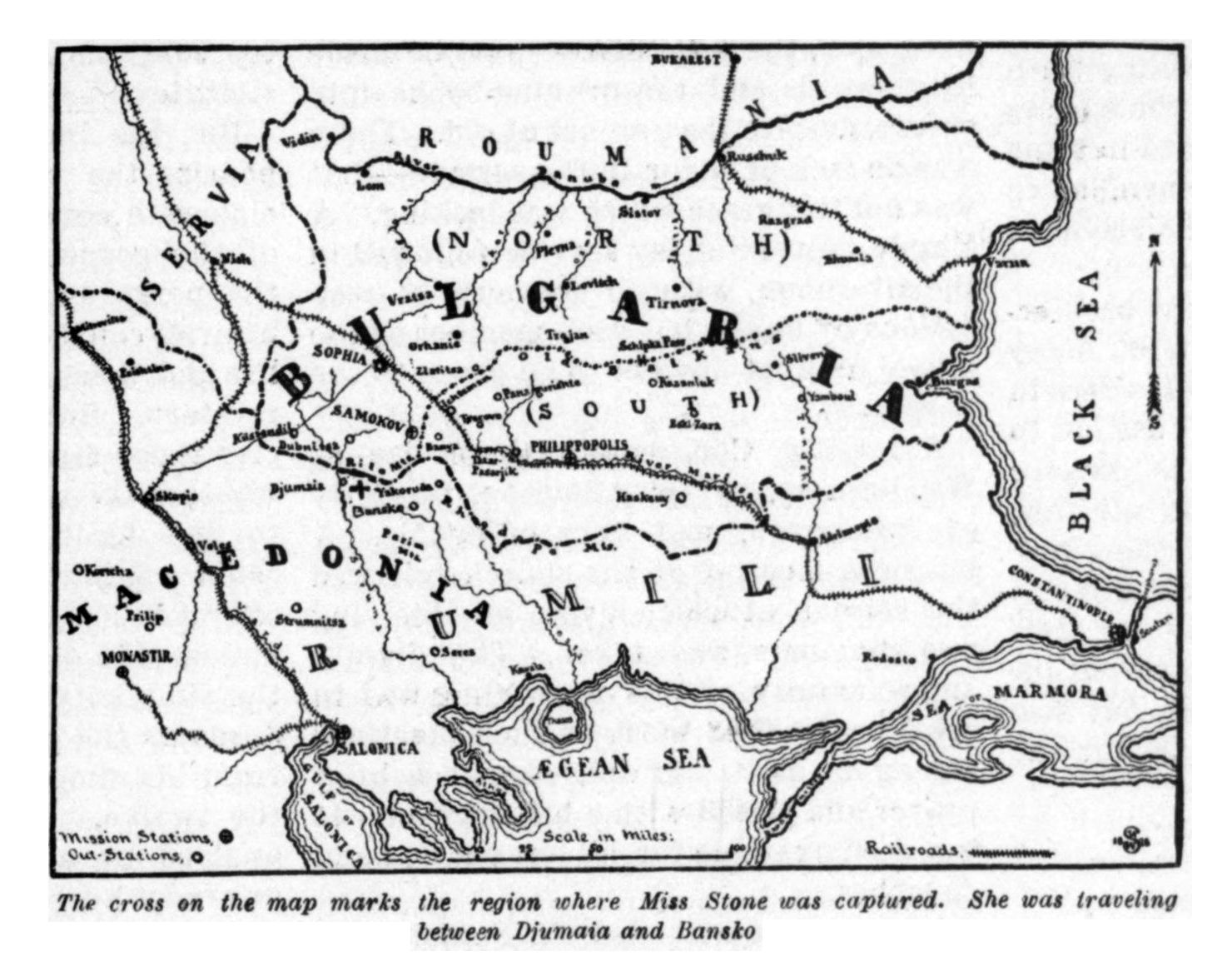
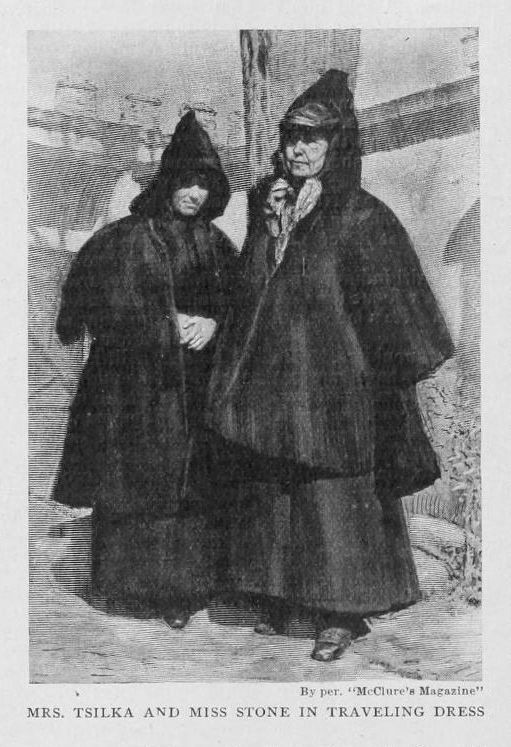
On the afternoon of September 3, 1901, Miss Ellen M. Stone fell prey to this audacious plot[11]. She was traveling by horseback with a small party of local Christians – including her friend and translator, Mrs. Katerina “Madame” Tsilka – after leading a Bible class in Bansko, a village in the Pirin Mountains. As they wound through a narrow mountain defile en route to Djumaya, masked gunmen suddenly “swooped down on the party”, firing shots and shouting commands[12]. In the chaos, a Turkish cavalryman escorting the group was brutally killed on the spot[13]. Stone and Tsilka found themselves surrounded by about twenty armed brigands, whom the shocked missionaries later described in a ransom letter as “bearded, fierce of face, wild of dress… all athletic and heavily armed”[14]. The attackers spoke only Turkish and made a show of being ordinary bandits motivated purely by money, concealing their revolutionary aims.
After the initial ambush, the captors released the rest of the party – including a pregnant villager and several men – retaining only Miss Stone and Mme. Tsilka as hostages[15]. Katerina Tsilka, at 23 years old, was seven months pregnant and the wife of an Albanian Protestant pastor. A Macedonian by birth, she had been educated in American mission schools and even in the United States before returning to the Balkans as a missionary teacher[16][17]. Now she and her mentor Miss Stone were forced to march into the wilderness at gunpoint. Tsilka later recalled the moment they learned why they’d been taken: “Three of the brigands...entered the hut... and told us that they had taken us for money, and should hold us until the ransom was forthcoming. ‘If it is not paid,’ he said menacingly, ‘there will be a bullet for you and a bullet for her.’” It was a nightmarish turn of events – America’s first international hostage crisis was unfolding in the mountains of Macedonia.
News of the kidnapping spread quickly. Missionary circles in Bulgaria and Turkey were aghast that an American woman – a respected 55-year-old missionary – had been seized by brigands. U.S. diplomats in Constantinople were notified within days. The popular press seized on the drama; newspapers and magazines from New York to London carried sensational headlines. The Christian Herald (a prominent religious weekly) ran a cover story in mid-October 1901 with Miss Stone’s portrait and the bold title “HELD BY BRIGANDS FOR A RANSOM,” fueling public anxiety and sympathy. Meanwhile, deep in the Balkan highlands, Miss Stone and Mme. Tsilka began a months-long ordeal as captives on the move.
Ransom Demand and International Response
Not long after the abduction, the kidnappers delivered their demands through letters dictated by Miss Stone. On September 26, 1901, Henry Haskell, an ABCFM mission station chief in Samokov, received a note in Miss Stone’s handwriting: the brigand-revolutionaries demanded 25,000 Turkish lira (≈ $110,000) in gold within a few weeks, or “both women would be killed.”[18] The deadline was set for early October. This exorbitant sum underscored the kidnappers’ true intent – it far exceeded any ordinary brigand’s ransom and was clearly aimed at funding a revolutionary war effort.
At first, American officials and mission leaders pressed the Ottoman authorities to intervene. The U.S. Minister in Constantinople, John G. A. Leishman, urged the Sultan’s government to hunt down the brigands and secure the missionaries’ freedom. However, the pursuit by Turkish soldiers quickly proved counterproductive. Miss Stone managed to smuggle out urgent pleas that any rescue attempts be halted. “Since Turkish soldiers and Bashi-Bazouks have begun to pursue us… our condition is altogether changed,” she wrote in a letter relayed via intermediaries. “I beg you to hasten the sending of the sum and… insist before the Turkish government that it stop the pursuit… otherwise we will be killed.”[19] In other words, the captors threatened to execute the women if the chase continued. Reluctantly, the Ottomans pulled back their forces, and American negotiators shifted tactics to quiet ransom negotiations.

Back in the United States, the public rallied to help “Save Miss Stone.” Churches held prayer meetings and collections; children in Sunday schools emptied mite boxes for the cause. The Christian Herald launched a special “Miss Stone Ransom Fund” and began publishing updates and donation totals. Contributions poured in from concerned readers (one donor famously wired $500) until tens of thousands of dollars were raised. By late fall, it was clear that the full demand could not be met by the initial deadline, so frantic appeals were made for mercy and more time. The brigands (via their contacts) eventually agreed to extend the deadline by a month in exchange for a smaller sum. In the end, about 14,000 Turkish lira (approximately $66,000) was painstakingly gathered – a huge amount, though still far less than the original demand[20]. Most of this money came from ordinary Americans’ donations and the coffers of missionary societies, testifying to the widespread empathy for Miss Stone’s plight[20].
U.S. President Theodore Roosevelt’s administration faced a dilemma: national honor and popular sentiment demanded action, yet a forceful intervention risked the hostages’ lives. This was uncharted territory – “twentieth-century America’s introduction to international political terrorism,” as one historian noted[21]. Ultimately, discretion won out. Diplomats like Minister Leishman and Ottoman mediators worked behind the scenes to arrange a ransom drop, even as public pressure mounted. The captors, for their part, remained adamant but also pragmatic. They reminded Miss Stone and Tsilka that keeping them alive and well was in everyone’s interest. “They told us it was to their interest to keep us in good health, as nobody would pay ransom for us if we were dead,” Miss Stone later recounted of her captors’ grim pragmatism.
Captivity
For over five months, Ellen Stone and Katerina Tsilka remained at the mercy of their kidnappers, marching through rugged terrain and hiding in forest camps to evade soldiers. The brigand band, led in the field by voivodas (leaders) such as Yane Sandanski himself, forced the women to travel mostly at night. “A mysterious party was moving cautiously and rapidly along the narrow trail… four or five men followed, then two horses, whose riders were carefully wrapped in long black kepes… on each side of both riders also marched other guards holding fast to their saddles,” Tsilka described of one midnight trek[22][23]. The kidnappers blindfolded Miss Stone and Tsilka during certain dangerous journeys and posted armed sentries at every rest stop. “Always, the women were under the close observation of their rude guardians, standing armed at the mouth of the cave or door of the hut… or tramping at their horses’ heads. On day journeys they rode blindfolded,” one contemporary account noted of the constant vigilance. Whenever rumors spread that Ottoman patrols were nearby, the brigands would hastily change course or prepare to fight rather than surrender their valuable hostages. Miss Stone later admitted that on several occasions they heard tense whispers around them and the clicking of rifles – terrifying signs that a clash might be imminent, and that they themselves could well be caught in the crossfire.
Despite these hardships, the captors generally refrained from physical harm and even showed occasional flashes of humanity. Both women were tough and resourceful. Ellen Stone, the older of the two, maintained a steadfast faith and reportedly even chided her abductors for their misdeeds. (The brigands jokingly complained to a reporter later about “the strong will of a middle-aged [missionary] woman” and her unrelenting moralizing[24]!) Tsilka, meanwhile, faced a more intimate trial: her pregnancy advanced into the final month during captivity. Exhausted by long marches and the winter cold, she nearly reached breaking point in early January 1902. One bitter night in the mountains, forced to climb on foot over rocks and thorns, the young woman collapsed. “Now for the first time I had no fear of the brigands, for they could do nothing worse than kill me… When they ordered us to climb I sat down and refused to move,” Tsilka recounted[25][26]. “‘Go,’ I said, ‘and leave me here to die in peace. It is wicked and outrageous to drive about a woman in my condition.’”[27][28] Even the hardened brigands were momentarily stymied. Finally, two of them wordlessly lifted the pregnant captive and “dragged [her] up the fearful mountainside,” carrying her when she could not walk[29].
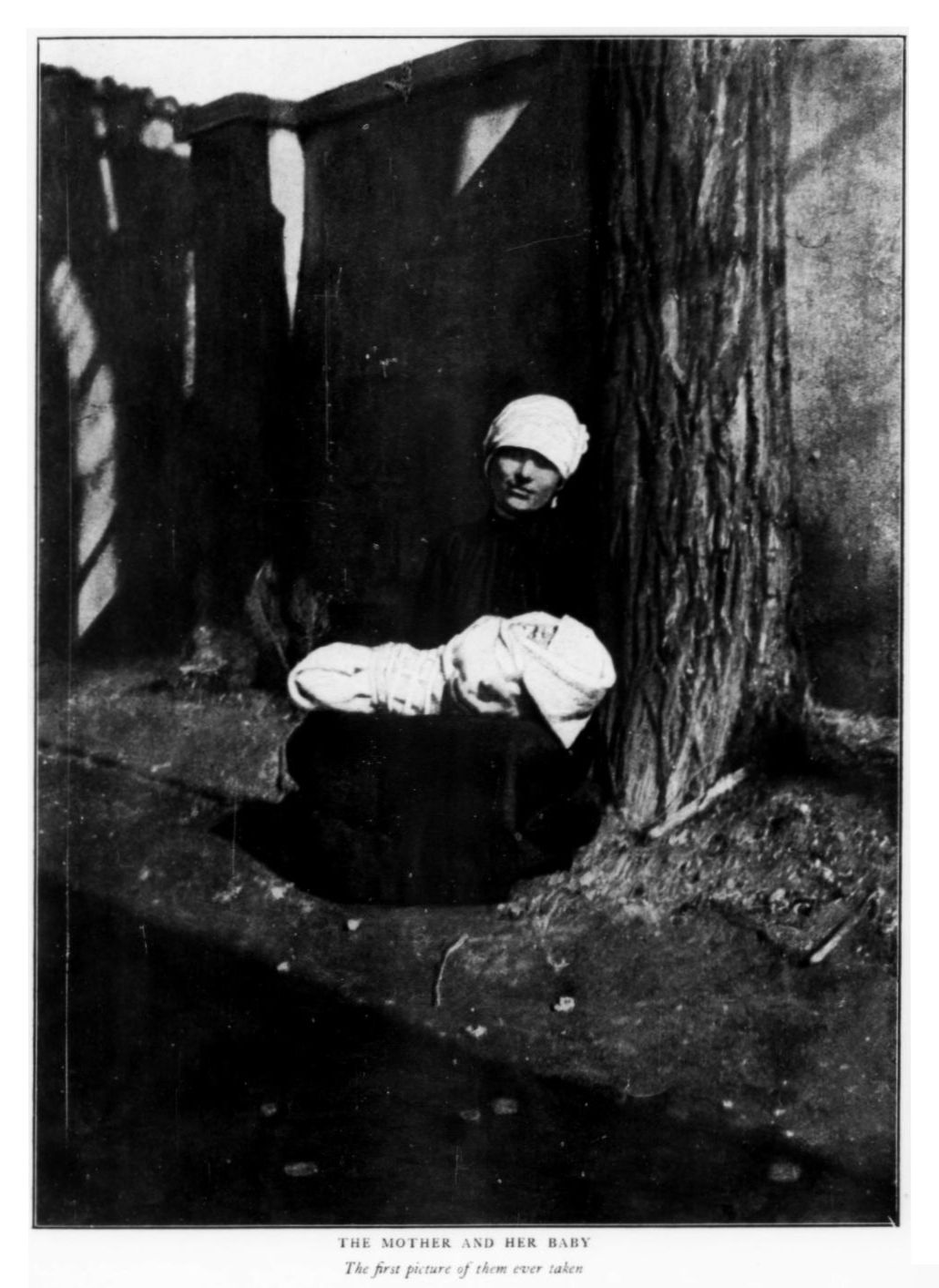
In the early hours of January 3, 1902, in a secluded hut high in the mountains, Katerina Tsilka went into labor. With no doctor or midwife available, it was Miss Stone – a lifelong teacher, not a nurse – who helped her through the delivery. By the grace of God, a healthy baby girl was born on that freezing night. The brigands were as astonished as the women. This was the first time a child had ever been born during one of their outlaw expeditions, and the event had a profound effect on the rough men. They nicknamed the infant “Kismetli” – a Turkish term meaning “the lucky one” or “Child of Fate” – because they believed her birth was an omen of good fortune. The brigand chief himself, a fierce fighter who had terrorized villages, now became unexpectedly tender toward the newborn. At first the baby’s cries startled and annoyed the outlaws, but soon the leader took the swaddled girl in his arms and gently warmed her tiny feet by the fire[30][31]. Tsilka watched in amazement: “He was no more a brigand to me, but a brother, a father, a protector to my baby,” she wrote of that moment[30]. The brigand chief even scolded his men to ensure the infant wouldn’t catch cold and asked Miss Stone for a list of supplies needed for mother and child[32][33].
Over the following days, the rough company of kidnappers transformed into doting “uncles” to the baby. They procured goat’s milk for the infant and allowed Tsilka and Stone slightly more comfort. One brigand delivered lengths of homespun cloth so the women could sew makeshift baby clothes and blankets in their cave shelter[34][35]. When Tsilka worried the band might kill her baby to simplify their escape, the leader decisively put those fears to rest. In fact, the birth became a source of pride among the outlaws. “We never had a baby born among us… This is an extraordinary event for us. We shall immortalize her name,” one of the brigands declared grandly[36]. That evening the entire band gathered to congratulate the new mother. The rugged men, who ordinarily might have seen a crying infant as a liability, took turns carefully holding the baby girl and offering small gifts. They even insisted on posing for a sort of impromptu “baptism” ceremony – with Miss Stone as the officiator – to give the child a name. In honor of their unusual circumstances, Tsilka named her newborn “Ella” (after Ellen Stone) as a gesture of gratitude to her friend. The brigands, however, had their own nickname and continued to call the child “Miss Stone’s baby” with playful affection[37][38]. Incredibly, for a brief time, the kidnappers and captives bonded over the innocent new life in their midst. Miss Stone later noted that after the baby’s birth, the band’s treatment of the women improved markedly – “we were treated more like free people and not as captives”, allowed small liberties though never outright freedom[39][40].
Yet the danger was far from over. Winter in the mountains was brutal, and the tension of waiting for ransom weighed on everyone. The women and the baby spent long cold nights in smoky huts and damp caves, with scant food and constant uncertainty. As weeks passed beyond the original ransom deadline, tempers surely frayed. Ottoman troops were still patrolling in the distance, and the brigands feared an ambush during the handover of money. Miss Stone and Tsilka’s fate hung in the balance each day that the ransom deal remained unfulfilled.
Negotiation and Release
Behind the scenes, February 1902 brought intense negotiations to a head. The ransom funds – 14,000 Turkish lira in gold coins – had been secretly assembled and entrusted to William Peet, the treasurer of the American Mission in Constantinople[41]. Through an American intermediary, arrangements were made with the kidnappers to exchange the money for the captives at an isolated location. Both sides were wary: the IMRO brigands feared betrayal or a police trap, and the U.S./Ottoman side feared the brigands might take the money and harm the women anyway. Ultimately, an elaborate plan was agreed upon. Under cover of night, agents for the missionaries left the ransom in bags at a prearranged spot in the mountains near the town of Strumica (in present-day North Macedonia)[42]. Once Sandanski’s men retrieved the gold and counted it – a bit disgruntled that it was considerably less than demanded – they prepared to free Miss Stone and Mme. Tsilka as promised[43][44].
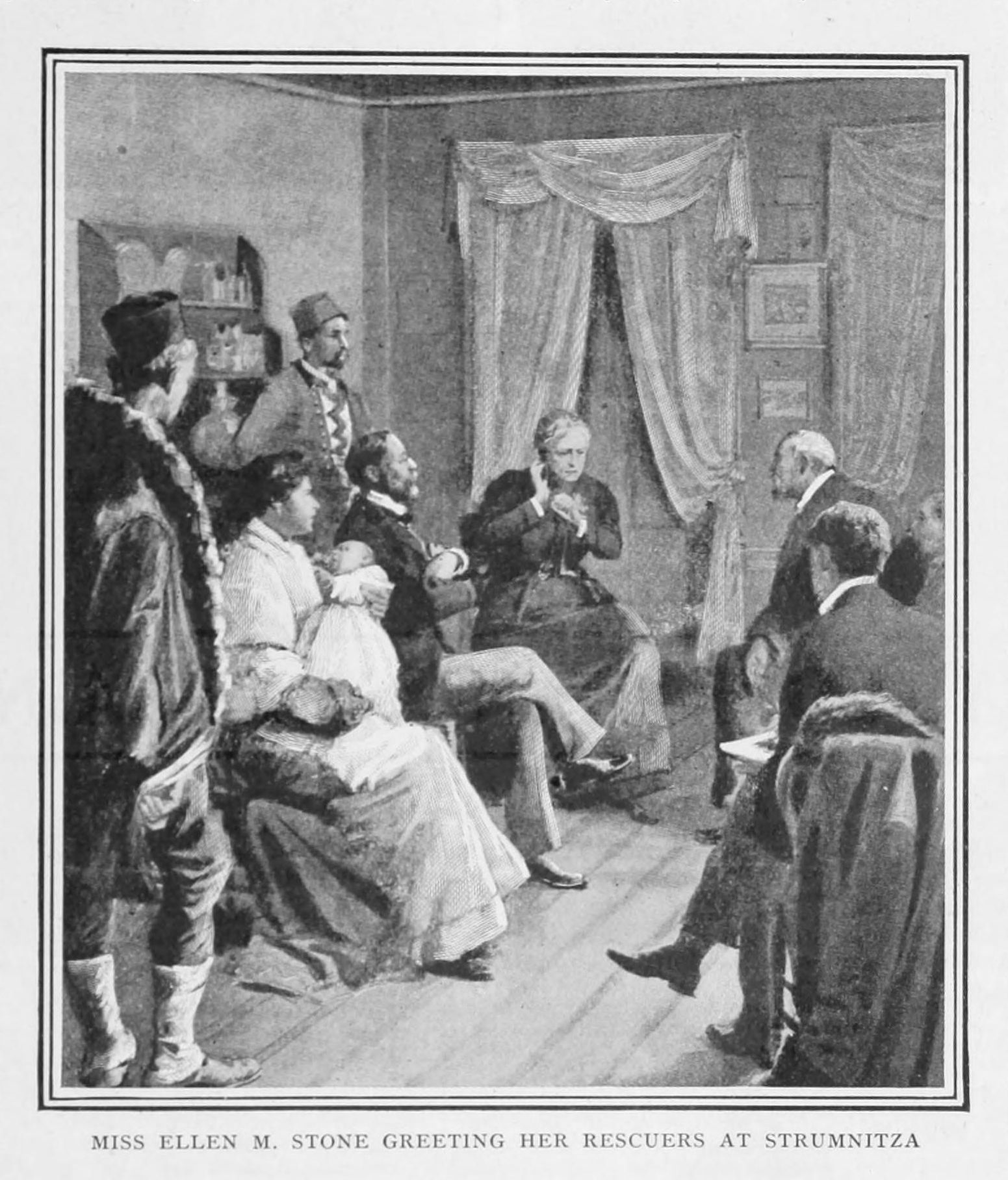
In the early morning hours of February 23, 1902, the two women and baby Ella were led to a lonely spot beneath a pear tree in the foothills outside Strumica[45][46]. There, just before dawn, the brigand chief and his comrades said their farewells. They pressed a few gold coins into Katerina Tsilka’s hands – purportedly gifts for the baby – and then melted away into the darkness. Ellen Stone and Katerina, holding the infant bundled in homespun blankets, were alone and free for the first time in 173 days. Dazed and unsure of their exact whereabouts, they walked until they encountered a poor Albanian shepherd who guided them down the road. Soon they reached a village, where the Protestant pastor in Strumica joyfully took them in.
Word of Miss Stone’s liberation flashed across telegraphs to Sofia, Istanbul, and on to the United States. In Strumica, an English journalist witnessed their emotional send-off as local people gathered in celebration. “The whole excited populace had gathered to wish them godspeed,” he reported of the scene as Miss Stone, Mme. Tsilka, and the baby departed Strumica under escort of American officials. Throngs of Bulgarian well-wishers crowded around to shake the former captives’ hands or even kiss them in congratulation. At the edge of town, a group of Miss Stone’s own converts – village women and schoolchildren she had taught – sang “God Be With You Till We Meet Again” in Bulgarian, bringing tears to her eyes. The “Luck Child” born in the mountains had indeed survived, and now the missionaries were safely on their way back to civilization.
After a brief stop in Salonica, Miss Stone and the Tsilkas traveled to Sofia, Bulgaria, and then onward to Europe. Reporters in Vienna caught up with Ellen Stone as she journeyed home. “The brigands treated Mrs. Tsilka and me as well as they could,” she told one interviewer, explaining that the outlaws never forgot the value of their “living investment”. “They said nobody would pay a ransom for us if we were dead.” She expressed heartfelt gratitude to all who had worked and prayed for their freedom, from U.S. diplomats to Bulgarian friends and American donors. In May 1902, Ellen Stone, Katerina and baby Ella arrived in the United States to a hero’s welcome. Church bells rang and crowds cheered as the women stepped off their ship in New York. Miss Stone publicly thanked the readers of The Christian Herald “for every loving thought, prayer, and gift” contributed toward their ransom and safe return. She even wrote personally to the Herald’s editor to acknowledge the outpouring of support. After six harrowing months among brigands, the nightmare was finally over.
Aftermath and Long-Term Impact
The Miss Stone Affair had wide-ranging repercussions. In the immediate aftermath, Ottoman authorities were embarrassed by the incident and suspicious that local Bulgarians had colluded with the revolutionaries. (Indeed, rumors swirled that Mme. Tsilka’s husband, Pastor Tsilka, had advance knowledge or even shared in the ransom money – an accusation strenuously denied by both women. Miss Stone called the very idea “absurd,” and the American mission pressed for Mr. Tsilka’s release when Turkish police briefly detained him.) In truth, the real culprits – Sandanski and his IMRO fighters – remained at large. The $66,000 ransom (nicknamed the “Miss Stone Fund” or “Miss-Stonki” by the revolutionaries) was put to use financing the Macedonian insurgency[47]. Just a year later, in August 1903, IMRO-led rebels launched the Ilinden Uprising against Ottoman rule. Although that rebellion was crushed, it is notable that the arms and supplies for the campaign were likely paid for “by Miss Stone’s gold.” In this way, the kidnapping succeeded in its goal of materially aiding the revolution. It also dramatically raised IMRO’s profile around the world – for better or worse, the Macedonian cause now had the attention of the American public.
For the United States, the affair was an eye-opening encounter with modern political kidnapping and terrorism. The Roosevelt administration had struggled to balance moral principle with practical reality when dealing with the hostage crisis[48][49]. There was no FBI or Delta Force to swoop in; instead, patience and ransom prevailed. Many observers later noted that Americans had been oddly sympathetic toward Miss Stone’s captors, viewing them not simply as bandits but as freedom fighters battling an oppressive empire. Because the brigands were Macedonian Christians and their enemy was the Muslim Ottoman regime, American public opinion tended to “hold the Big Stick in check”, as one analysis put it[50]. Few Americans blamed the revolutionaries as harshly as they blamed “the Turks” for allowing such lawlessness in the first place. The whole episode was morally complex – even Miss Stone herself, once safely home, showed remarkable lack of bitterness toward her former abductors.
Miss Stone spent the rest of her days as something of a celebrity in missionary circles. After recuperating in Massachusetts, she embarked on a speaking tour, recounting her experiences to spellbound church congregations. People were keen to hear “fuller accounts of her experiences during her long captivity,” and Miss Stone obliged with vivid lectures. She also quietly lobbied the U.S. Congress to reimburse those who had contributed to her ransom, believing it unjust that private donors bore the cost of what was essentially a diplomatic ransom. (Years later, Congress did appropriate some funds to repay the “Miss Stone ransom,” though not all donors were tracked down.) Mme. Katerina Tsilka and her husband resumed their missionary work for a time, but eventually they too emigrated to America. Baby Ella – the “brigand baby” – was presented to fascinated audiences during a brief fundraising tour in 1902, though Katerina shielded her child from the limelight thereafter.
The long-term impact on missionary work in the Balkans was nuanced. Protestant mission efforts in Macedonia continued, though the Ottoman government remained deeply suspicious of foreign missionaries. The bravery and faith shown by Miss Stone and Mme. Tsilka under duress became an inspirational story told in missionary journals for years to come. In fact, Ellen Stone herself used her newfound fame to advocate for the Macedonian people’s welfare. In 1903, as brutal warfare engulfed Macedonia, she wrote a moving appeal on behalf of the very people whose rebels had kidnapped her. “God grant that this appeal on behalf of the Christians who have so long suffered under their Moslem rulers… may reach hearts tender to pity them,” Miss Stone implored in an open letter, urging Americans to support relief efforts for Macedonian civilians. It was a striking example of Christian forgiveness and “returning good for evil” – Miss Stone harbored no resentment; instead, she showed compassion for the populace and even empathy for the rebels’ cause of liberation. Her former captor, Yane Sandanski, reportedly respected Miss Stone’s courage and later claimed that no harm had come to her in captivity except what hardship the mountains imposed.
In retrospect, the Miss Stone Affair has been called “America’s first modern hostage crisis.” It foreshadowed dilemmas the U.S. would face repeatedly in the 20th century when its citizens were abducted abroad. At the same time, it became a legendary tale in Bulgaria and North Macedonia – a testament to the lengths revolutionaries would go for freedom, and to the extraordinary human bonds formed in adversity. Missionary publications of the era referred to it as a “romance of missions” – equal parts tragedy, adventure, and testimony of faith[51][52]. Over a century later, the story of Ellen Stone and Katerina Tsilka’s captivity still captivates those interested in Balkan history. It is a saga of conviction and sacrifice: a band of passionate freedom fighters willing to defy empires, a devoted missionary who risked her life in a foreign land, and two women whose grace under trial turned a violent encounter into a tale of enduring inspiration.
References
[1] [3] [4] [20] [42] “Ellen M. Stone.” Wikipedia. Last edited February 28, 2025. Accessed February 10, 2026.
https://en.wikipedia.org/wiki/Ellen_M._Stone
[2] [7] [8] [9] [10] [11] [12] [13] [14] [15] [18] [19] [21] [24] [41] [45] [46] [47] [48] [49] [50] Woods, Randall B. “The Miss Stone Affair.” American Heritage 32, no. 6 (October/November 1981). Web edition (digital reprint dated February 2026 on site). Accessed February 10, 2026.
https://www.americanheritage.com/miss-stone-affair
[5] [6] “The Situation in Macedonia.” The Missionary Herald 99, no. 7 (July 1903): 300–304. (American Board of Commissioners for Foreign Missions.)
[16] [17] “The Story of ‘Mme. Tsilka.’” Life and Light for Woman 32, no. 6 (June 1902): 277–280. (Woman’s Board of Missions.)
[22] [23] [25] [26] [27] [28] [29] [30] [31] [32] [33] [34] [35] [36] [37] [38] [39] [40] Tsilka, Katerina (Katerina Stefanova Tsilka). “Born Among Brigands: Mrs. Tsilka’s Story of Her Baby.” McClure’s Magazine 19, no. 4 (August 1902): 290 (listings) and 292–300 (article pages).
[43] [44] “Among Brigands.” The Missionary Herald 98, no. 3 (March 1902): 133–136. (American Board of Commissioners for Foreign Missions.)
[51] Stone, Ellen M. “What Lies Behind the Balkan War? Part II.” Life and Light for Woman 43, no. 2 (February 1913): 59–63.
[52] Stone, Ellen M. “The Opportunity in Albania.” Life and Light for Woman 27, no. 4 (April 1897): 145–148.